
by: Emma Howe (Deputy Headteacher, Temple Hill Primary Academy)
Hello Everyone! My name is Emma Howe and I am the Deputy Headteacher at Temple Hill Primary Academy. As a leader, I genuinely believe that every child deserves to have their voice heard.
This is why we recently introduced Oracy: to put speaking and listening at the very heart of our curriculum. We did this because we know this is what our children need, not just because the recent curriculum review now says it must be taught. And we are already seeing the results! I recently invited to share the impact that Oracy is having on our children’s writing at National Conference in London. As a school, we are incredibly proud of our journey so far and the progress our children are making.
So, what is Oracy?
Oracy is the ability to articulate ideas, develop understanding, and engage with others through spoken language. In school, we often talk about reading, writing and maths, but oracy is just as vital. It is more than just speaking; it is about learning to talk and learning through talk. It is this skill which weaves itself through every single subject and beyond at Temple Hill.
Why does this matter?
Let’s be honest: in the real world, first impressions count.
Before a person even reads our qualifications or sees what we are capable of, they often make a snap judgement based on how we communicate. We want our children to walk into any room, whether it’s a secondary school interview, a university hall or a future workplace and command attention because they speak with confidence and clarity.
But it’s not just about “sounding good.” Oracy has massive benefits for children right now and in the future… Academically, it’s a superpower. There is a direct link between talking and learning. Put simply: strong speakers make more progress. When children learn to articulate their thoughts clearly out loud, they find it much easier to write those thoughts down on paper. Oracy deepens their thinking, expands their vocabulary, and boosts their performance in almost every subject.
It also prepares them for the real world. We want our children to be Global Citizens, people who can listen with empathy and disagree without falling out. Whether they are resolving a conflict on the playground today or negotiating a business deal in twenty years, the ability to listen, understand, and express themselves is the most valuable tool they will ever own.
Finally, and perhaps most importantly, “research shows that young people with good communication skills are less likely to suffer from mental health difficulties. In fact, children with poor communication skills are 1.5 times more likely to struggle with their mental health. By teaching them to speak up, we are giving them a protective layer for life.” (Voice 21 and The Communication Trust).
So, what does this look like at school?
At Temple Hill, we help our children become confident communicators by teaching them that there is a time to explore and a time to perform. Also known as Exploratory Talk and Presentational Talk.
Exploratory Talk
Think of this as talking to think – this is where you learn through talk. It is the verbal equivalent of a rough draft or scribbling notes on a pad.
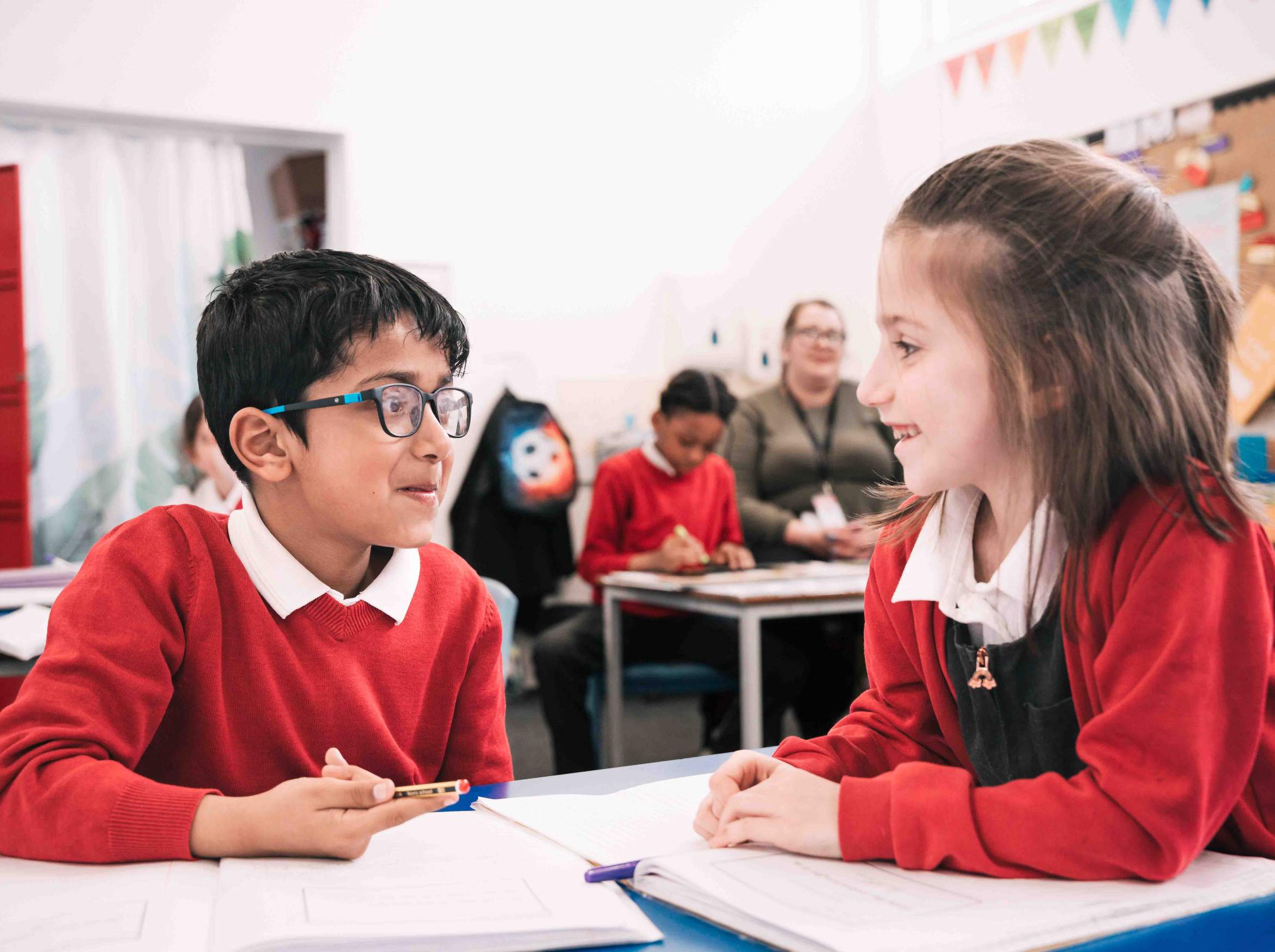
- What it looks like: Children working in groups, interrupting each other with ideas, saying “maybe…” or “what if…”, and changing their minds. Listening to others is key here – something which can be really tricky to master!
- Real Life Example: Imagine you and your family are trying to decide where to go on holiday, or you are trying to assemble flat-pack furniture with someone. You aren’t giving a speech; you are tossing ideas around, disagreeing, and figuring it out together. We teach children that in this mode, it is okay to be messy and unfinished – that is the sound of thinking happening!
Presentational Talk
This is talking to an audience or a more ‘polished’ way of speaking. Once the thinking is done, this is how we share it with the world.
- What it looks like: Standing up tall, speaking clearly, making eye contact, and using formal language to explain an idea to the class or an assembly.
- Real Life Example: This is the skill you use in a job interview, when making a speech at a wedding, or presenting an idea to a boss. We teach children that in this mode, clarity, volume, and word choice matter because the goal is to be understood and persuasive.
At the end of the day, our goal is simple. We want to send our children out into the world equipped not just to survive, but to thrive. We want them to have the courage to stand up for what is right, the vocabulary to paint pictures with their words, and the confidence to say, ‘Here I am, and this is what I think.’ We never want a brilliant idea to stay locked inside a child’s head simply because they couldn’t find the words to let it out. A child who can speak with confidence is a child who can change the world. Let’s give them that power, together.
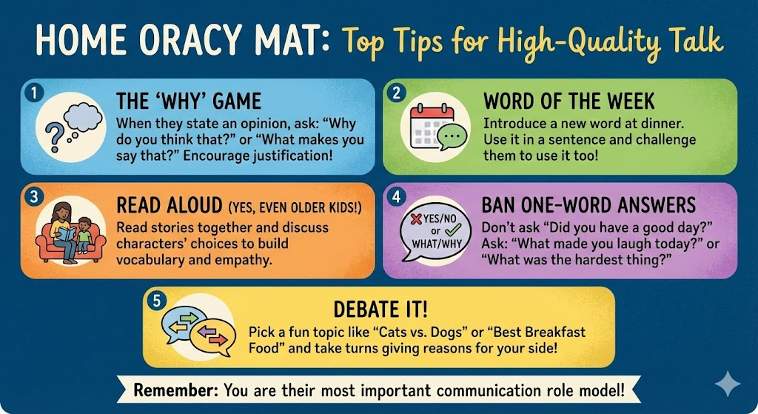
Want to find out more? Get in touch with us! Come and visit to see Oracy in action or talk to our children to find out more. Are you a parent and want to support your child with this at home? Try some of the strategies below.